Before using the Well Reporting System it is important to have a good understanding of how the data is structured (linked) within the database. Due to the well-structured database design, with clearly defined relations between the data, it is possible to work according to the “once in – many out” principle. As a result, each piece of information only has to be entered once and will be retrieved many times on a variety of outputs (i.e. reports). Below a schematic of the top-level data structure is given.
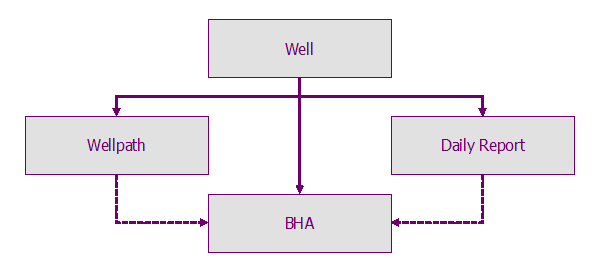
Each of the top-level items in the database (i.e. Well, Wellpath, BHA and Daily Report), is defined as a Data Entity Type. An instance of a Data Entity Type (e.g. a specific BHA or Daily Report) is referred to as a Data Entity has its own form for editing. The top-most data entity type is the Well. Each Wellpath, BHA and Daily Report is linked to a specific well. Without a well, the other data entity types cannot exist in the database.
A Wellpath can be the entire wellbore or any part thereof. If a well is not sidetracked, a well has typically one single wellpath. Wellpaths cannot overlap, so if the same depth range is drilled, a new wellpath must be created (which is logical, as it is not possible to drill the same section of the same wellbore twice).
Another requirement is that each well has a minimum of one wellpath. This is typically named 'Main wellbore', but wellpath names may be freely chosen.
The dotted lines in the above diagram represent a logical, rather than a direct database relation. For each BHA the related wellpath (i.e. the wellpath the BHA was used on) must be input. Subsequently, a BHA can only be used on a single wellpath.
Daily operations (a data subset of a daily report) are labeled with an activity code, the BHA number (if applicable), an end depth (for that activity).
Using the above relations, the following can be calculated:
1.From specific activity codes and the BHA reference on the daily operations, the date-time in and date-time out are calculated as well as the depth in and depth out.
2.From the activity codes the total drilling, circulating, reaming and run total hours are calculated.
3.From 1. and 2. above the total distance drilled and ROP are calculated.
4.From the wellpath reference, depth in and depth out, the drilling parameters, survey summary and formations drilled for the BHA run are retrieved from the wellpath data.
Note that for legacy BHA's to be entered, it is not necessarily required to input all daily operations, drilling parameters etc. Per BHA, each data section may be locked against overwriting on calculation and can thus be input manually.
|
Copyright © 2023 Softdrill NL |